

Common SalesTech Implementation Mistakes and How to Avoid Them
 Darshan JainDecember 18, 20252 Mins read8
Introduction
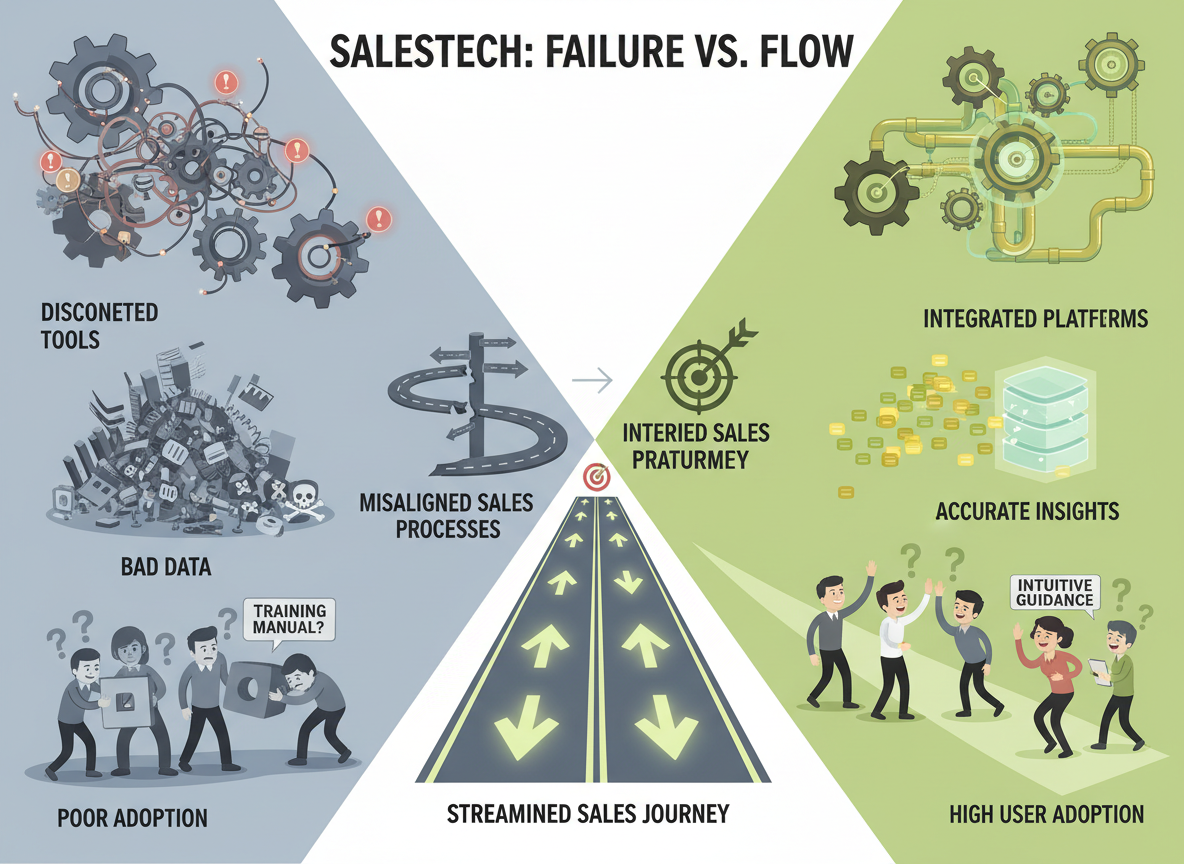
Many B2B organizations invest heavily in Sales Technology expecting immediate improvements in productivity and revenue. When results fail to materialize, the tools are often blamed. In reality, the failure usually lies in how SalesTech is implemented, not in the technology itself.
SalesTech amplifies existing processes. If those processes are broken, SalesTech will simply expose the problems faster.
This article breaks down the most common SalesTech implementation mistakes and explains how B2B teams can avoid them.
Mistake One Buying Tools Without Clear Sales Processes
SalesTech is frequently purchased before sales workflows are defined.
This leads to:
- Confusion among sales reps
- Inconsistent deal management
- Low tool adoption
- Fragmented data
Avoid this by clearly defining:
- Sales stages
- Qualification criteria
- Handoff rules
- Reporting expectations
Technology should support process, not define it.
Mistake Two Overloading the Sales Stack
More tools do not equal better sales performance.
Overloaded stacks result in:
- Duplicate functionality
- Tool fatigue among reps
- Poor integration
- Incomplete data usage
Avoid this by selecting tools with clear roles and eliminating overlap. A simpler stack with strong adoption always outperforms a complex one.
Mistake Three Ignoring Data Quality
SalesTech depends entirely on data accuracy.
Poor data leads to:
- Inaccurate forecasts
- Misleading dashboards
- Low trust in reports
- Bad decision making
Avoid this by enforcing data standards, validating inputs, and holding teams accountable for data hygiene.
Mistake Four Lack of Sales Team Adoption
Even the best SalesTech fails if sales teams do not use it properly.
Low adoption is caused by:
- Poor onboarding
- Unclear benefits for reps
- Excessive manual data entry
- Tools that slow down selling
Avoid this by training teams properly and demonstrating how SalesTech directly improves productivity and deal outcomes.
Mistake Five Weak Sales and Marketing Alignment
SalesTech implementation often ignores alignment between sales and marketing.
This causes:
- Conflicting data
- Disputed lead quality
- Broken handoffs
- Inconsistent reporting
Avoid this by agreeing on definitions, sharing dashboards, and creating feedback loops between teams.
Mistake Six Treating SalesTech as a One Time Setup
SalesTech is not set and forget.
Problems arise when:
- Workflows are never reviewed
- Tools are not updated
- Processes do not evolve
- Performance data is ignored
Avoid this by continuously reviewing performance and refining how tools are used.
Final Thoughts
SalesTech failures are rarely about the software. They are about poor planning, weak processes, and lack of discipline.
When implemented with clarity, alignment, and accountability, Sales Technology becomes a powerful driver of predictable revenue and scalable sales execution.







Leave a comment